
SQL Server Migration/ Modernization Services
Azure Managed Services that keep your cloud stable, secure, and under control every day

SQL Server Migration/ Modernization Services
SQL Server versions have defined end-of-support (EOS) dates from Microsoft, marking when security updates and technical support cease. SQL Server 2016 reaches EOS on July 14, 2026, while 2019 ends mainstream support around 2025 but has extended support in January 2030. We help CIOs, IT leaders, and DBAs run a structured SQL server migration to Azure, AWS, or GCP. Our approach reduces security gaps, limits compliance exposure, and helps you avoid forced hardware purchases. You also gain stronger performance, better cost control, and reliable continuity through Microsoft SQL server migration.
Get in Touch
SQL Server & Windows Server EOL Is Not a Future Problem
Calance SQL Server Migration & Modernization Services
We provide SQL server migration and modernization across the full lifecycle, from assessment through post-move support. Each phase is planned around your environment, so your SQL server database migration stays controlled and predictable.
Assessment & Readiness Review
- We complete a current-state inventory and version mapping. Next, we confirm dependencies, rate risks, and build a clear SQL server migration roadmap. This creates a practical path forward.
Migration Planning
- We sequence workloads and plan migration waves. Then, platform selection and licensing choices match your goals. Cutover planning reduces SQL server data migration disruption and keeps stakeholders aligned.
Database Migration Execution
- We move schema and data to the target platform with clear controls. We also configure instances and migrate SSIS, SSRS, SSAS, SQL Agent jobs, and related components for complete Microsoft SQL server migration.
Application Compatibility Remediation
- We test and update T-SQL, stored procedures, drivers, and connection strings. In addition, we fix deprecated features and behavior changes so applications run as expected after we migrate SQL server workloads.
Modernization Engineering
- We improve query patterns and indexing to support performance targets. When needed, we refactor the schema for the chosen platform. These steps strengthen SQL server migration results and future scaling.
Cutover & Go-Live Management
- We define downtime windows and run final sync steps. Then, validation checks confirm readiness for go-live. Rollback steps protect production during SQL Server database migration cutover.
Post-Migration Optimization
- We tune performance and right-size resources to control spend. After that, we stabilize operations and set governance basics. Your environment runs efficiently after Microsoft SQL server migration.
Managed Support Options
- Our ongoing DBA support covers monitoring, patching, and operational care. In addition, change control reduces risk over time. Teams get steady coverage after SQL server data migration.
What Staying on EOL Infrastructure Actually Costs You

Why Modernization
| Approach | What It Means | When It Fits | What It Doesn't Solve |
|---|---|---|---|
| Rehost (Lift & Shift) | Move SQL Server to a cloud VM with minimal changes | Speed is critical. Apps have complex dependencies. Quick EOL exit required. | Legacy architecture, high licensing cost, missed PaaS benefits |
| Replatform | Migrate to a managed SQL service (Azure SQL MI, RDS) with targeted adjustments | Workloads are largely compatible. Ops overhead reduction is a goal. | Application-level inefficiencies, schema-level modernization needs |
| Refactor | Redesign database architecture, schema, or access layer for cloud-native patterns | Long-term scalability, performance, or cost optimization is the driver. | Requires more time and change management; not suitable for all workloads |
A Structured Method Across Every Migration Phase
Plan
Build
Migrate
Validate
Cutover
Optimize
Target Platform Options
We are platform-flexible. We help you assess and select the right target based on workload needs, existing cloud agreements, compliance requirements, and long-term architecture direction, not based on any vendor preference.
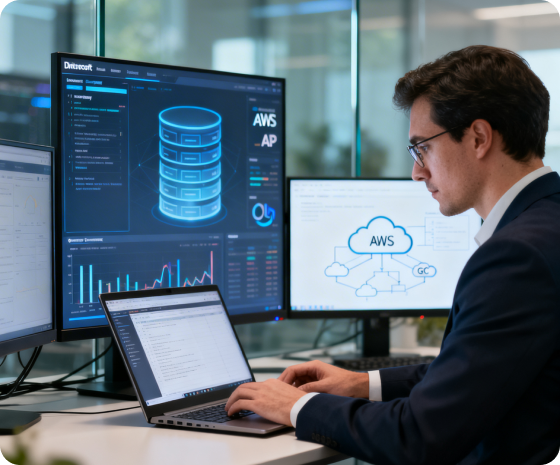
Unsure About Azure, AWS, or GCP for Your SQL Workload?
Wondering which platform fits your SQL Server migration best? It comes down to your workloads, licensing, compliance needs, and current cloud setup, not vendor hype. We offer unbiased evaluations in every assessment to guide your SQL Server database migration decision.
Why Calance Is the Best Choice for Your SQL Server Migration
Most organizations migrate SQL Server only once in a long cycle, but we deliver SQL server migration work every week across complex environments. We know the hard parts, including linked servers, SSIS estates, and job chains. You get structured delivery that protects production stability and supports compliance during SQL server database migration.
Discovery-First Approach
We map dependencies like SSIS, SQL Agent jobs, and linked servers before SQL server migration begins. Clear documentation reduces missed items and supports secure changes across the estate.
Platform-Agnostic Guidance
We do not push a preferred cloud. We recommend Azure, AWS, or GCP based on workload needs and licensing position. This improves SQL server data migration fit and cost outcomes.
Structured Delivery Phases
Each phase has defined outputs from assessment through optimization. You track progress and risks in clear checkpoints throughout Microsoft SQL Server migration delivery. There is no guesswork.
Post-Migration Continuity
After go-live, we provide monitoring setup, knowledge transfer, and support options. Your team operates with clarity after SQL server data migration completes, with help available when needed.
Start with an Assessment — Get a Migration Roadmap in Weeks
Not sure where to begin your SQL Server migration? Our assessment gives you a full inventory, dependency map, platform pick, risk list, and phased roadmap fast. It's the smart, low-risk first move for smooth SQL Server database migration.
Frequently Asked Questions
Downtime depends on database size, change rate, network throughput, and cutover model. We use baselines and rehearsals to estimate the window, then confirm it with a pilot run.
Yes, in many cases. We use phased waves and controlled sync methods so users stay on the current system until the final cutover window.
We inventory and map them early, then rebuild or modernize where needed. We also validate schedules, permissions, and dependencies before go-live.
We identify cross-db calls, linked servers, and credentials during discovery. Then we design the target pattern and test each dependency in a staging environment.
For large or busy systems, we plan for staged movement, delta sync, and a tightly controlled cutover. We also tune performance to keep sync times predictable.